ZireSafari
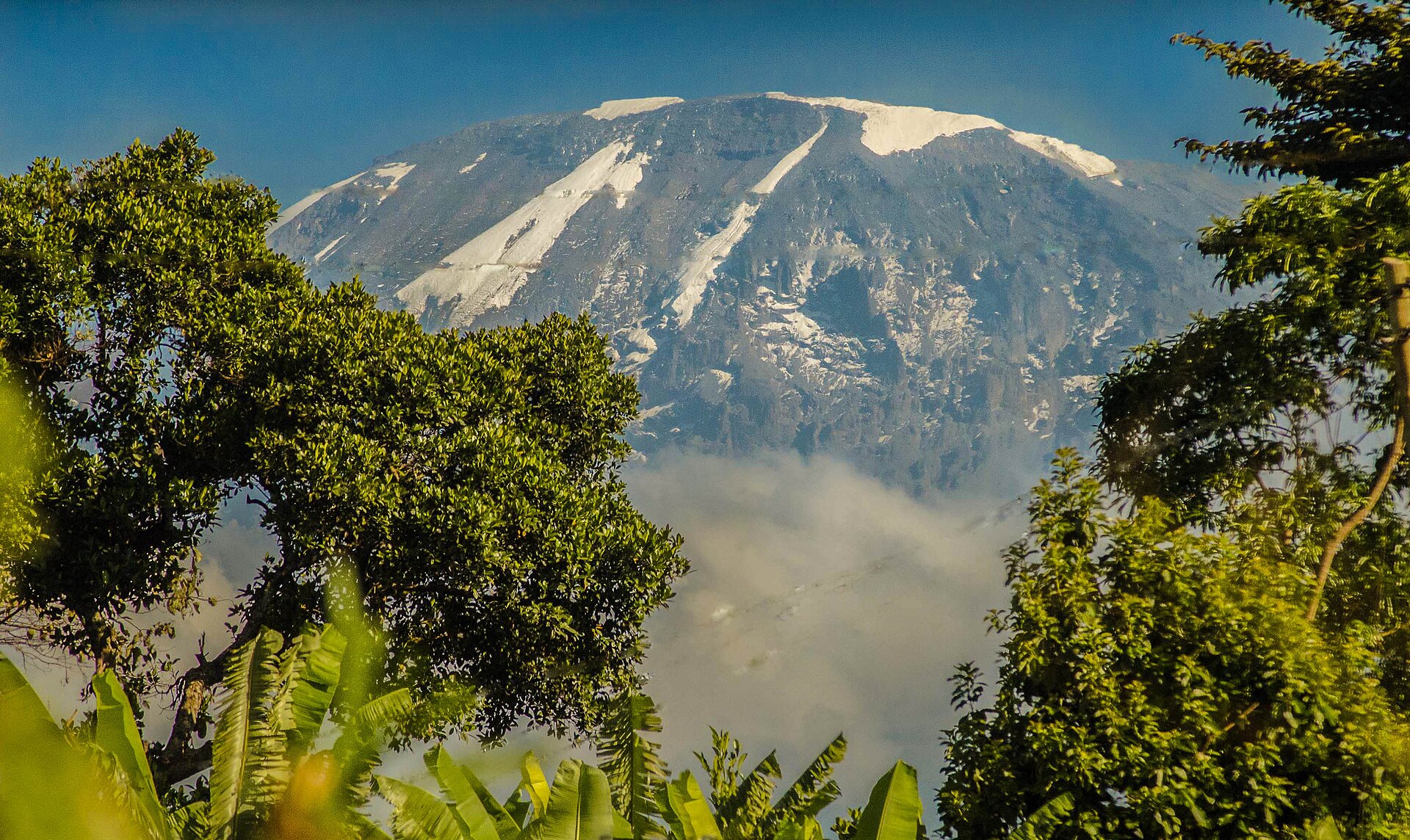
The snow-streaked summit of Kibo on Mount Kilimanjaro above clouds, framed by banana and forest trees in the foothills

Kilimanjaro · 5,895 m

Climbing Kilimanjaro

Routes, difficulty, cost and season, set out in one place.

Where every journey becomes a story

The mountain

A walk to 5,895 metres, not a technical climb.

Kilimanjaro is the highest mountain in Africa and the tallest free-standing mountain in the world. The trek to Uhuru Peak crosses five climate zones in under a week: farmland, rainforest, heather and moorland, alpine desert, then the arctic ground of the summit.

No ropes, ice axes or climbing experience are needed. What the mountain asks for is time. Altitude, not terrain, is what turns people back, and the single biggest decision you make is how many days you give your body to adjust.

5,895 m
Uhuru Peak

19,341 ft, the highest point in Africa.

5
Climate zones

Farmland, forest, moorland, alpine desert, arctic.

7–9
Days we advise

Longer profiles summit far more reliably.

None
Technical skill

Walking, not climbing. Fitness and patience.

The routes

Six ways up, and one night in the crater.

Every route ends at Uhuru Peak. They differ in length, gradient, scenery, traffic and where you sleep. Longer profiles acclimatise better and summit more reliably.

Western approach · our first recommendation

Lemosho Route · 10 days total · 8 mountain

Starts remote on the western side, crosses the Shira Plateau, then joins the southern circuit near Lava Tower. The gradual profile and the extra time below 4,000 metres make it the best acclimatiser of the popular routes, and the scenery is the finest on the mountain.

In its favour

Varied scenery and a gradual approach

Bear in mind

Busy in peak season, costs more than Marangu

Distance
~70 km
Success rate
Not guaranteed
Best time
June–October, January–March
Sleeping
Tents
Approach
West
Kilimanjaro route comparison
RouteDaysDistanceSuccessSleeping
Lemosho10 days total · 8 mountain~70 kmNot guaranteedTents
Machame9 days total · 7 mountain~62 kmNot guaranteedTents
Marangu7 days total · 5 mountain~64 kmNot guaranteedHuts
Northern Circuit11 days total · 9 mountain~98 kmNot guaranteedTents
Umbwe9 days total · 7 mountain~53 kmNot guaranteedTents
Rongai9 days total · 7 mountain~72 kmNot guaranteedTents
Crater Camp extension+1 day+4 km round tripSubject to health checkTents in the crater

Difficulty

How hard is it, honestly?

Fit walkers with no mountain experience summit Kilimanjaro every week of the season. The difficulty sits in three places, and all three can be planned for.

Altitude

Thin air, not steep ground

Air pressure and available oxygen decrease with altitude. Headache, nausea, poor sleep and loss of appetite can indicate altitude illness: report symptoms promptly to your guide. Worsening symptoms may require immediate descent. Acclimatisation is bought with days, which is why we steer every guest towards seven nights or more.

Fitness

Can a beginner do this?

Yes, and most of our climbers are beginners. If you can walk 15 to 20 km over hilly ground and repeat it the next day, you are fit enough. Build that with hill walking, running, cycling or swimming over two to three months before you travel.

Summit night

The one genuinely hard day

You leave base camp around midnight for six to seven hours of cold, slow switchbacks in the dark, then descend more than 2,000 metres the same day. Cold, altitude and exhaustion present real risks; your guide sets the pace and may turn the group back for safety.

On the mountain

What a day actually looks like.

Days follow the same shape whichever route you walk. You carry a daypack; porters carry everything else. Walking is deliberately slow, four to six hours on most days, longer on the two big ones.

Your guide checks oxygen saturation and pulse morning and evening, and briefs the following day over dinner. Bottled oxygen and a full medical kit travel with the crew on every climb, for emergencies rather than routine use.

  1. 06:30

    Wake and wash

    Tea at the tent, warm washing water, and your daypack repacked while the crew strikes camp.

  2. 07:30

    Breakfast and health check

    A hot cooked breakfast. Your guide records pulse and oxygen saturation and asks how you slept.

  3. 08:30

    Walk, four to six hours

    Deliberately slow, pole pole. Frequent water stops, a packed or hot lunch on the trail depending on the day.

  4. 15:00

    Reach camp

    Tents already pitched, hot drinks and popcorn in the mess tent, an hour or two to rest or wander.

  5. 18:30

    Second health check

    Vitals again, then dinner: soup, a main course, fruit, and the briefing for tomorrow.

  6. 20:00

    Sleep early

    Nights are cold and dark by seven. On summit night you sleep at 19:00 and rise before midnight.

Before you go

Six things to settle first.

When should I climb?

Late December to early March and mid-June to late October are the driest, clearest windows. The wet months are not off limits: rain usually arrives in the afternoon, and northern routes such as Rongai see a fraction of the rainfall of the southern slopes.

Best: Jan–Mar, Jun–Oct

How many days?

Five-day itineraries exist and we do not recommend them. Seven to nine days on the mountain gives your body time to adapt and is the strongest single predictor of reaching the summit. Add a night in Moshi Town either side.

Seven nights or more

What does it cost?

A comfortable, properly staffed seven-day private climb sits in the region of USD 2,800 to 3,400 per person. Park fees alone account for roughly a third of that, which is why very cheap quotes usually mean cuts to crew, food or safety equipment.

Park fees are a third of it

How do I train?

Be able to run five kilometres without struggling and hike ten or more in a day. Long weekend walks with a loaded daypack and boots you have already broken in are worth more than gym work.

Two to three months

What about altitude sickness?

Acute mountain sickness is the real risk on Kilimanjaro, and in rare severe cases it becomes life threatening. Prevention is a long itinerary, a slow pace, three to four litres of water a day, and a guide who checks you twice daily and will turn you around when needed.

Oxygen carried on every climb

What do I need to pack?

Layers for +20 °C at the gate and −15 °C at the summit: broken-in boots, a four-season sleeping bag, insulated jacket, waterproof shell, gloves, headtorch and poles. We send a full checklist on booking, and most items can be hired in Moshi Town.

Hire available in Moshi Town

Key facts

Kilimanjaro on paper.

Highest point
Uhuru Peak, 5,895 m / 19,341 ft
Distinction
Tallest free-standing mountain in the world
Also
Highest mountain in Africa, one of the Seven Summits
Volcano
Three cones: Kibo, Mawenzi and Shira
Protection
Kilimanjaro National Park, a UNESCO World Heritage Site
Climate zones
Cultivation, rainforest, heather and moorland, alpine desert, arctic
First ascent
1889, Hans Meyer and Ludwig Purtscheller
First female ascent
1927, Sheila MacDonald
Glaciers
One of the few places in Africa with permanent ice
Nearest airport
Kilimanjaro International (JRO), about 50 minutes from Moshi

FAQs

Questions we are asked most.

How do I get to the mountain?

Fly into Kilimanjaro International Airport (JRO), served from Amsterdam, Doha, Istanbul, Addis Ababa and Nairobi. Transfer to Moshi Town is arranged around your flight; driving time depends on traffic. We meet every guest at arrivals.

What insurance do I need?

A policy that explicitly covers trekking to 6,000 metres, helicopter evacuation and medical repatriation. Standard travel insurance often excludes high altitude, so check the wording before you buy.

What are the summit odds?

On seven- to nine-day itineraries with a well-run crew, the great majority of climbers reach Uhuru Peak. On five- and six-day itineraries the failure rate rises sharply, and that is a function of the schedule rather than the walker.

Can I climb in the rainy season?

Yes, and rates are lower. Choose a northern route, Rongai or the Northern Circuit, where rainfall is a fraction of the southern slopes, and expect afternoon showers rather than all-day rain.

What about tipping the crew?

Tips are customary and pooled across guides, cooks and porters. Budget roughly USD 250 to 350 per climber for a seven-day climb; your guide explains the split at the final briefing.

Can I add a safari or Zanzibar?

Most guests do. Two or three days in Tarangire, the Ngorongoro Crater or the Serengeti after the climb works well, as does finishing on the coast. Kilimanjaro comes first in the itinerary, never after the beach.

Plan with ZireSafari

Tell us your dates and your walking history. We will recommend a route.

Private climbs on every route, departing any day of the year. We hold your place while permits and hotels are confirmed.